
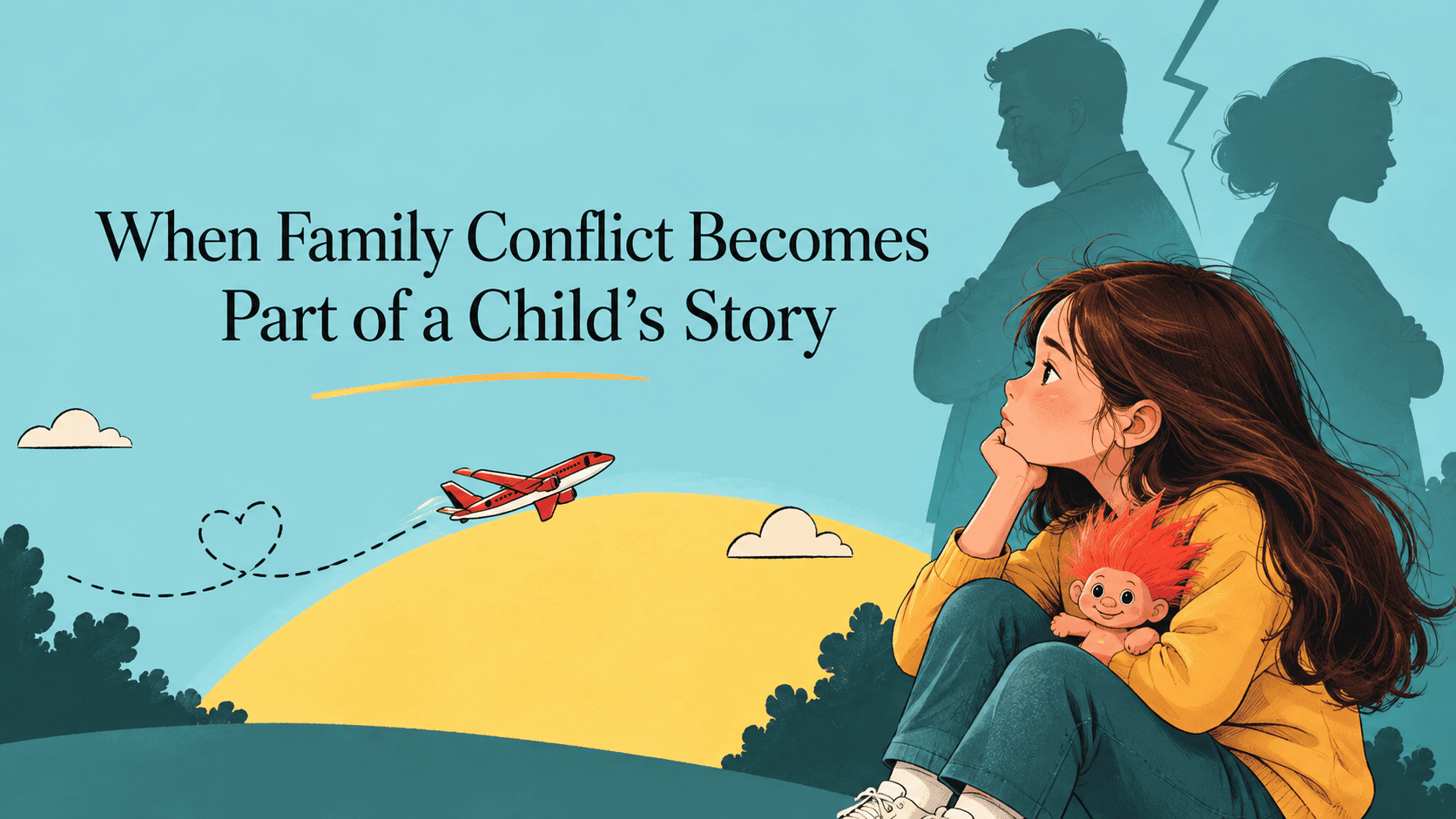
A new toy should be easy to enjoy. Yet in one coming-of-age memoir, an orange-haired troll doll becomes a significant part of a child’s story, revealing how family conflict can shape her words and actions. Her mother takes it from her, asks who gave it to her, and throws it toward her father’s departing car after hearing her stepmother’s name. Afterward, she knows to be careful about mentioning her stepmother at home.
In Girl in Flight, Cat Buchanan remembers this moment as a change in what she could safely share at home. A pleasant evening with her father, George, and stepmother, Susan, has upset her mother, Meyera. The girl did not create the disagreement, but she is the one left reconsidering her answer and wondering which name she should have left out.
Family conflict has reached beyond the argument into the girl’s next conversation. She wants to enjoy a toy, talk about her evening, and love the people she loves without causing another upset. Those wishes should not require such careful handling.
The Marriage Ends, but the Disagreement Remains Part of a Child’s Story
The parents’ divorce is complete when their daughter is two. Meyera and her mother, Meme, buy an apartment building in Brentwood and live in separate apartments there. George initially stays nearby, hoping for reconciliation. The formal ending of the marriage does not create a clean separation between their lives, and the child remains part of the relationship they struggle to manage.
Calling it an acrimonious divorce identifies the hostility, but the child’s account makes its meaning more specific. She has to return from visits, answer questions, and depend on people who are angry with one another. What might be described by adults as an arrangement becomes, for her, a series of encounters whose mood she cannot control.
It would be too simple to say that having two homes is the problem. The trouble in these pages lies in the demands and reactions that accompany movement between them. Her affection for one person becomes difficult to express around another. Even an ordinary answer can seem to take a side when the adults are already listening for evidence of disloyalty.
The story distinguishes between a marriage ending and a child being repeatedly drawn into the aftermath. Its revealing details concern what these particular adults do after they have stopped being husband and wife.
When a Happy Memory Becomes a Difficult Part of a Child’s Story
Before the doll is thrown, the evening has gone well. The restaurant has a toy display, and the girl knows that good manners at dinner may earn her a present. She keeps her elbows off the table and does her best to eat properly despite her braces. She leaves holding something she has wanted, pleased that she has followed the rules.
At home, those rules no longer help. Saying who gave her the toy is enough to turn pleasure into trouble. Her immediate response is to reconsider her wording. Perhaps mentioning only her father would have been safer. Susan’s name becomes the detail she wishes she could take back.
It is a painful detail for a childhood memoir to preserve: the girl looks for a mistake in her own answer before questioning why she needed a different one. Someone gave her something nice, and she was happy about it.
The scene also gives readers interested in mother-daughter relationships something more demanding than a simple account of closeness or distance. A daughter can remain attached to her mother while becoming careful about what she tells her. In this instance, protecting that relationship seems to require hiding happiness experienced elsewhere. The cost is visible in the narrator’s description of becoming cautious about showing her love for Susan.
An Invitation to Dinner Turns Into a Journey Across the Country
One of the clearest examples of the conflict entering everyday life begins with an apparently ordinary request. George asks permission to take his daughter out to dinner. Meyera agrees, unaware that the meal will be served on a flight from Los Angeles to New York. When she discovers what has happened, she follows, despite having the flu, and turns to her friend Joan Barker for support.
The episode is striking because dinner usually promises a return. In this case, the invitation becomes a way of moving the child into a dispute taking place thousands of miles away. Ten uncertain days follow as the adults and their lawyers argue over her return and where an assessment should take place.
There is a sharp difference between the scale of the adult argument and the child’s immediate position. The grown-ups discuss her welfare, but she is already living through the consequences of their decisions. The question of where she should be becomes something other people debate while she waits for permission to go home.
On the return flight, a small exchange brings the story back to the girl herself. Meyera complains about the long journey, and her daughter suggests reading or watching the movie. She has also packed a chocolate bar for her mother. After all the demands and negotiations, she is still thinking about how to make the trip easier for the adult beside her.
Also read : Using humor as a lifeline
When Telling the Truth Feels Like Taking a Risk
The appointments that follow introduce another difficulty: speaking openly might appear to threaten the home she wants to keep. Her older friend Eleanor tells her that remaining in California depends on withholding information from the psychiatrist, Dr. Bets. Family, friends, and school all become subjects to handle carefully.
The girl takes this advice seriously. After each session, she reports back to Eleanor, who examines the questions for possible traps. An ordinary inquiry about school can acquire a dangerous meaning when she believes the answer might help determine where she will live. The conversation is no longer simply about how she is doing. It becomes a test she thinks she must get through.
For readers choosing a coming of age memoir, this episode offers a close look at the difference between being asked a question and feeling free to answer it. The narrator describes herself as aware of the psychiatrist’s role in her parents’ dispute. Her short replies make sense within that fear, even though they make honest understanding more difficult.
Eleanor’s advice belongs to the girls’ attempt to influence an outcome, not a model for handling a real assessment. The child believes her ordinary life is at stake and trusts someone who seems to understand what she wants to protect.
By the final appointment, even the way she greets her mother has been discussed in advance. The girl is trying to appear natural while carefully managing her behavior. It is a sad contradiction: a meeting intended to understand her relationship becomes another place where she feels responsible for presenting it correctly.
The Party Goes On Without Her
Not every consequence of family tension involves a dramatic confrontation. Sometimes it is an evening that slips away while an adult decides there is still plenty of time. The Christmas party episode is especially telling because the child has already contributed something to it: cookies that look rather different after baking than she intended.
Meme finds a silver platter that improves their presentation. Guests gather, music plays, and the party belongs to the familiar life of the apartment building. George has been invited but feels uncomfortable attending, so he takes his daughter out for dinner instead. He promises they will return before the evening is over.
After the meal, he suggests a movie. She asks about the party, and he reassures her that there is enough time. There is not. They return after the guests have left, and she finds photographs of the cookies she made. Her contribution has been attended to without her.
The disagreement is quiet but clear. George wants to avoid an uncomfortable return to the gathering; his daughter wants to be there. Their evening together allows him to postpone what he would rather not do, while she loses something she was looking forward to. The movie and meal do not answer that disappointment simply because they might otherwise have been enjoyable.
The photographs remain meaningful to her. They preserve a small piece of an occasion she helped prepare but missed. In a story full of expensive outings, these homemade cookies make the absence personal. She wanted a place in the evening, not another way to spend it.
Missing Someone Is Not the Same as Taking Their Side
Susan’s place in the girl’s life makes the question of divided loyalty particularly difficult. When George’s second marriage ends, his daughter arrives expecting to find her stepmother and baby sister, Cynthia. Instead, her father tells her they are gone and that their names must not be mentioned again. Susan is also removed from the photograph albums.
The instruction leaves little room for the girl’s own loss. Her father has ended a marriage, but she has lost daily access to people she loves. Those experiences are connected without being identical. A rule against speaking their names cannot settle what they mean to her.
Earlier, Susan’s name had become difficult to say around Meyera. Now it is forbidden around George. The two situations place different pressures on the girl, but both restrict her ability to speak freely about an important relationship. Her feelings remain, even when the permitted family conversation no longer has room for them.
This is where a child’s story needs space separate from the adults’ version. She can miss her stepmother without making a judgment about every part of the marriage. She can love her sister without agreeing to the terms on which the adults have separated. Remembering these relationships lets the reader see what disappears when the family account is reduced to who left whom.
There Are Still Other Things to Look Forward To
The memoir does not leave its young narrator waiting beside a suitcase in every scene. When Laurel arrives to look after her during a summer visit, the girl is delighted. There are swimming plans, cheerleading routines to learn, and the excitement of spending time with someone young enough to make the days feel like an adventure.
That enthusiasm matters because it gives the reader more than a record of conflict. The girl still has interests and a sense of fun. She can become completely absorbed in a new friendship or an activity without every moment serving as a comment on her parents. We are allowed to enjoy her company rather than only worry about her.
It is tempting to gather all of this under the word resilience. Yet that description is most useful when it leaves the unfairness intact. Having a good afternoon does not make the difficult parts of the summer harmless. Being able to laugh does not make a demand reasonable. Her pleasure deserves recognition without becoming evidence that she needed less care.
Read Beyond the Question of Which Parent Was Right
A family story can easily become an invitation to choose a side. This one rewards a closer reading. Rather than deciding which adult deserves the final word, consider what happens when their daughter tries to have a word of her own. Her preferences are often small enough to be overlooked: attending a party, keeping a gift, or mentioning someone she misses.
Three questions help keep that perspective in view:
- What does the child actually want in this scene? Separate her immediate wish from the larger outcome the adults are arguing about.
- What must she leave unsaid to keep the situation calm? Notice when a pleasant memory or an honest answer becomes difficult to share.
- Who bears the cost of the adult’s choice? Look beyond the explanation to the missed occasion, interrupted relationship, or uncomfortable journey that follows.
These questions keep attention on the person growing up within the disagreement. They also make space for self-discovery as a gradual process: recognizing that her feelings deserve to be described, even when they do not fit the account an adult prefers.
Girl in Flight by Cat Buchanan gives those feelings a place on the page. Read it for a family story that notices what happens after the argument, when a child is left deciding what she can say, whom she can miss, and which parts of her life still belong to her.
Frequently Asked Questions
Is this a coming of age memoir about divorce or a broader family story?
It is a broader family story in which parental separation is an important part of the narrator’s childhood experience. Alongside that tension, the account follows friendships and the pleasures she finds during her visits. Readers can follow the family disagreements without finding that every experience is reduced to the divorce or every person defined only by their part in it.
Does the book explore a child’s relationship with a stepmother?
Yes. Susan is an important person in the girl’s life, and the difficulty of expressing that affection is central to several scenes. The story makes room for the child’s relationship with her stepmother as something meaningful in its own right, rather than treating it only as an extension of her father’s marriage.
Would this suit readers interested in difficult parents and mixed loyalties?
Readers looking for an account of affection complicated by anger, disappointment, and competing demands will find those questions throughout the book. The narrator shows what it is like to want a relationship while finding aspects of it painful. The reading experience asks for attention to particular encounters rather than a quick decision about which family member is entirely right.
Is this a guide to custody disputes or parenting after separation?
No. It is a memoir describing one person’s experiences, including a custody dispute and related appointments. Those episodes belong to the story and should not be read as professional guidance or a picture of how every family situation unfolds. Its value here is the close attention it gives to the child’s understanding of what is happening around her.
What could a reading group discuss without revealing the ending?
The early doll episode offers a useful starting point: why does the girl reconsider her answer instead of expecting the adults to manage their feelings? A group could also discuss the missed Christmas party and what the photographs preserve. Both scenes open a conversation about everyday consequences without requiring anyone to discuss the book’s final events.